

Medicaid is a vital program that nearly 11 in 32 Louisiana residents rely on for affordable health care. Last summer Congress passed a tax and budget megabill (H.R.1) that will bring sweeping cuts to Medicaid. Louisiana will pay the price in higher state costs, reduced federal funding, and new barriers to care for low-income residents.34
Louisiana’s budget for the 2027 fiscal year, which began on July 1, offers an early look at how H.R. 1 will affect health care in the state. Although many of the law’s most significant Medicaid funding cuts have yet to take effect, the budget already shows how Louisiana is bearing the consequences.
At first glance, the Medicaid budget appears relatively stable. But the headline numbers mask important changes beneath the surface. The details show how Louisiana will spend more money to cover fewer people as federal funding leaves the state.
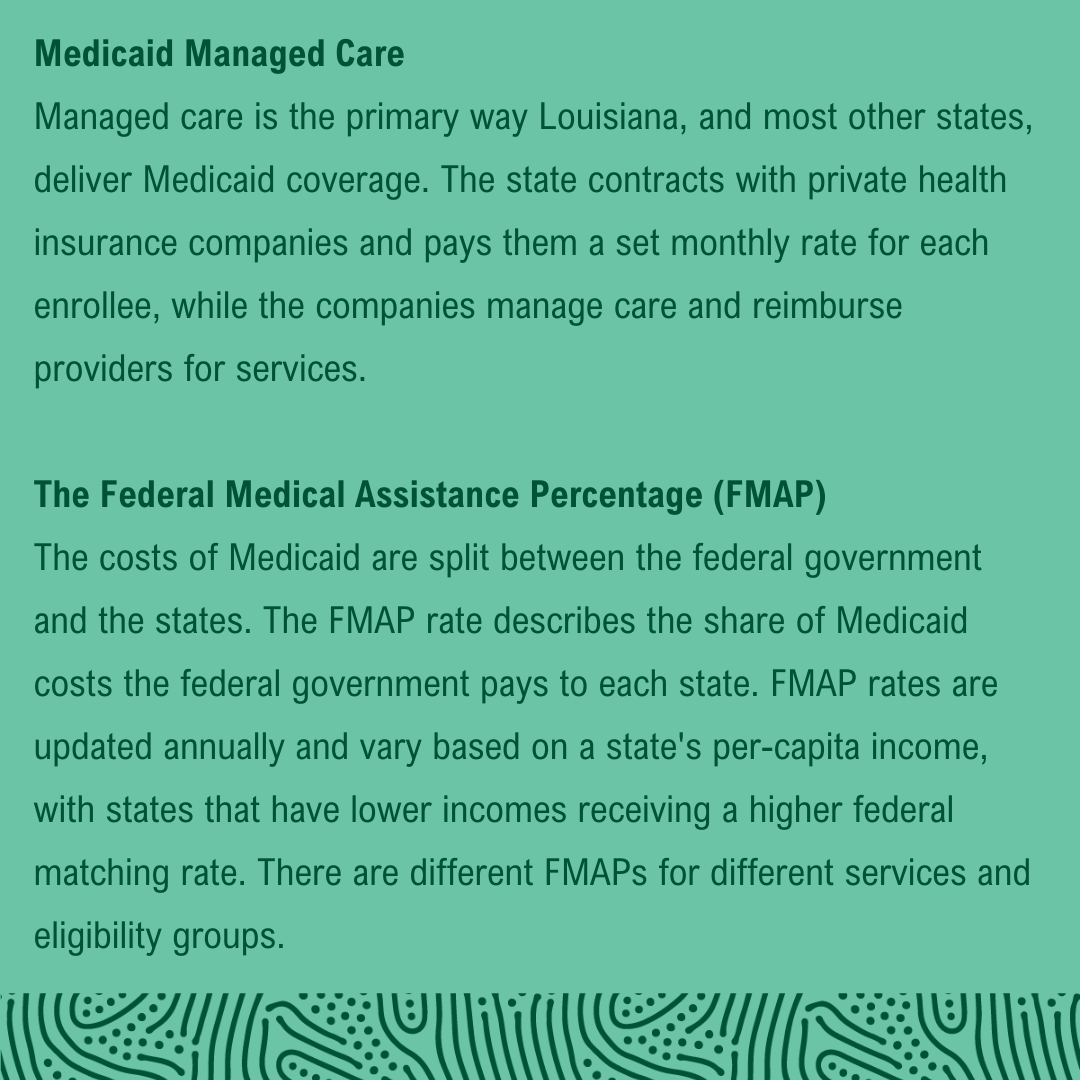
Medicaid Financing Basics

How H.R. 1 Changes Medicaid in Louisiana
Louisiana’s Medicaid system will undergo several changes in the next year due to the new federal law. Starting Jan. 1, Louisiana will implement strict work reporting requirements and more frequent renewals for Medicaid expansion enrollees (low-income adults aged 19-64 with household incomes up to 138% of the federal poverty level).5
Beyond these new eligibility requirements, the law also restricts Louisiana’s ability to finance Medicaid and improve access to care. The law prevents states from increasing certain provider taxes and limits their ability to expand SDPs, both of which Louisiana has used to increase payments to doctors and hospitals that treat Medicaid patients.6
The restrictions become even more severe in future years. Beginning in 2028, Louisiana will be required to gradually reduce some existing provider taxes and SDPs, limiting available funding for Medicaid.7 While these cuts have not yet taken effect, state policymakers are already making decisions in anticipation of the funding losses ahead.
Why Louisiana Will Spend More to Cover Fewer People
In Fiscal Year 2027, the Louisiana Department of Health (LDH) plans to spend more state dollars to cover fewer people in Medicaid. This outcome reflects a central feature of H.R. 1: it shifts health care costs to states while reducing Medicaid coverage for low-income people.
The department of health estimates that new eligibility requirements will reduce Medicaid enrollment by 21,091 people,8 though this is lower than other projections. The Urban Institute, for example, predicts enrollment declines in Louisiana between 123,000 and 264,000 people due to work reporting requirements and six-month renewals.9 These estimates are likely too conservative, as they predate a federal regulation10 issued in June that will put more paperwork requirements on Medicaid patients and will likely lead to even greater coverage losses.
Even under LDH’s more conservative estimate, the state expects to spend an additional $28.8 million in state general funds on Medicaid Managed Care Organization payments while losing $213.9 million in federal funding.11
To understand why spending increases even as enrollment falls, it is important to look at how Medicaid costs are shared between the state and federal government. The Affordable Care Act allowed states to expand Medicaid coverage to adults with low incomes. Former Gov. John Bel Edwards expanded Medicaid in Louisiana in 2016 without work reporting requirements.
For every dollar spent on Medicaid expansion enrollees, the federal government pays 90 cents and the state pays 10 cents. For every other enrollee, the federal share drops to somewhere between 68 and 78 cents, meaning the state is responsible for 22 to 32 cents of every dollar.12
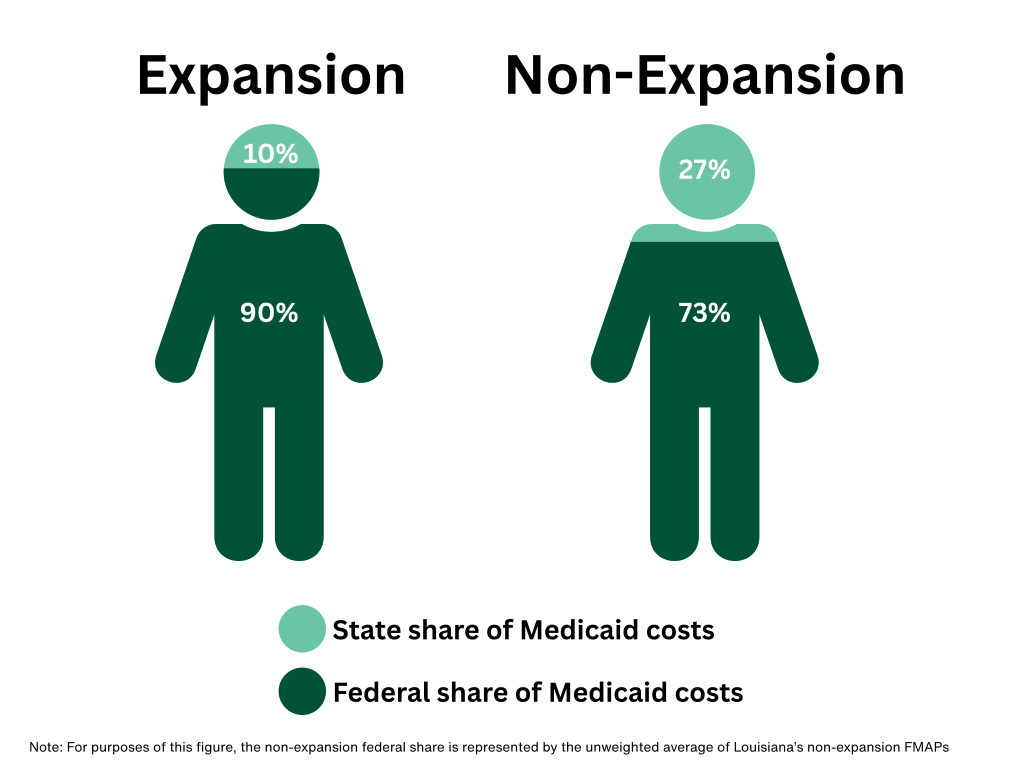
Federal policy changes will reduce Louisiana’s Medicaid expansion population by roughly 20,000 people, according to LDH estimates. Here’s why that costs the state more, even though it’s covering fewer people.
First, those 20,000 people were paid for at the best possible rate for the state: 90% federal, 10% state. When expansion enrollees lose coverage, the cost to cover the remaining Medicaid enrollees shifts toward the less favorable (non-expansion) match rate. The state carries a bigger share of the bill.
Second, expansion adults tend to be younger and need less expensive care than other adult Medicaid enrollees.13 When they leave, the people who remain, on average, have higher care needs. Medicaid managed care, like other health insurance, works on the principle that people who need less expensive care offset the costs of people who need more. When you remove people who require fewer services, the average cost per person for everyone else goes up.
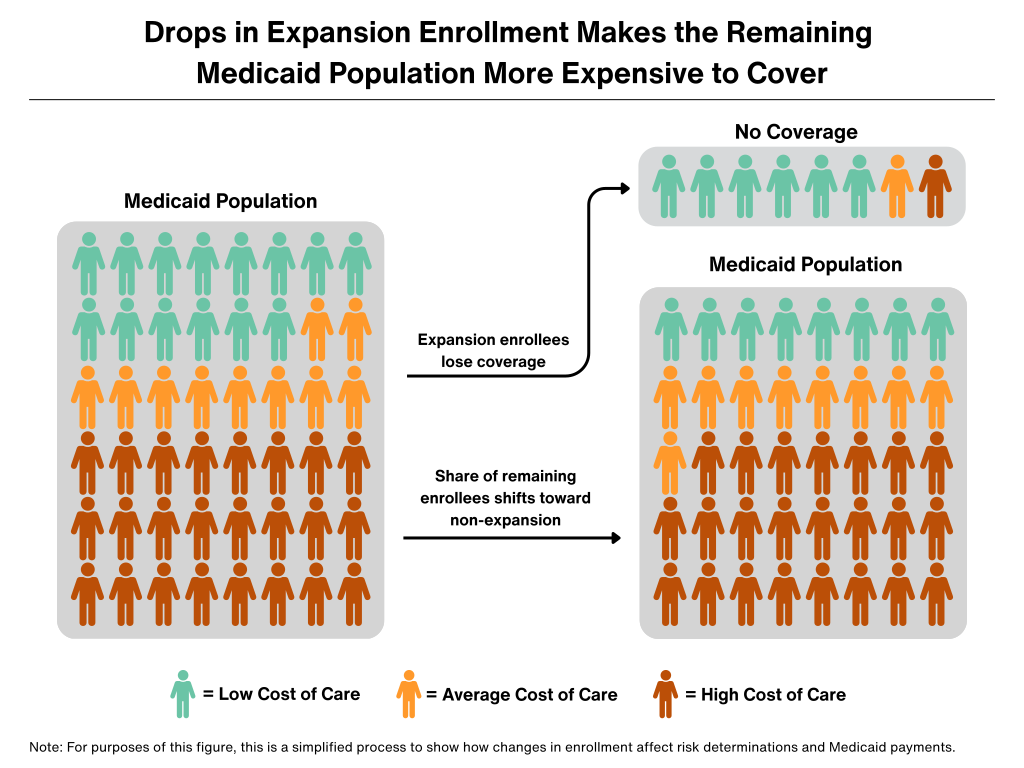
The bottom line: We’re losing people who are cheaper to cover and come with the most federal help, so the state ends up spending more of its own money to cover fewer people.
Net Impact on State Budget
This year, that extra $28.8 million cost to the state is partially offset by a slight increase to the FMAP. The updated FMAPs for non-expansion groups saves $26.9 million in state general funds,14 nearly making up for the new costs from eligibility changes. However, it is not a fix for the coverage losses. It is a coincidental offset that happens to soften the blow to the budget this year, but it does not necessarily protect Louisiana in the long run, nor does it prevent thousands of people from losing access to care.
Access to Care at Risk
Medicaid coverage is critical, but it does not guarantee care. And in Louisiana, many Medicaid recipients report issues with transportation, access to care, and the quality of care they receive.15
Louisiana has taken steps to address these challenges by using SDPs to pay doctors and hospitals more for treating Medicaid patients. Medicaid generally pays providers less than other types of insurance. Higher payment rates are intended to offset this gap and encourage more providers to treat Medicaid patients, improving access to care.
Last year, Louisiana used provider tax revenue to finance higher payments for providers focused on primary care, behavioral health, family planning, and women’s health. The higher payments meant these providers received 85% of what Medicare–the federally funded health insurance program for older adults–pays for certain services. State officials set a goal of reaching parity with Medicare by Fiscal Year 2028.16
Now, because H.R.1 set new limits on provider taxes, that goal appears increasingly out of reach. No additional rate increases are included in the FY 2027 budget, and discussions between legislators and LDH during budget hearings suggest that the law’s new restrictions on funding sources will make future progress more difficult.
Anticipated Consequences of H.R.1
Although Louisiana is still in the early stages of implementing H.R. 1, and the most significant changes to the state’s Medicaid financing—through provider tax and SDP cuts—have yet to take effect, the FY 2027 budget offers an early indication of what lies ahead.
New work reporting requirements and six-month renewals will create paperwork barriers that cause Louisianans to lose health coverage. Rather than generating savings, these coverage losses will force the state to spend more of its own dollars to cover fewer people, while federal funding flows out of Louisiana.
Today, Medicaid provider payment increases that policymakers expected to deliver are being left on the table. In the years ahead, the consequences will become more severe: lower payments for physicians, less access to care for patients, and mounting pressure on state budgets.
These outcomes are neither accidental nor surprising. They are the foreseeable consequences of federal policy decisions that Louisiana’s elected officials endorsed.
References
- Louisiana Department of Health. (2025, May 1). Medicaid Enrollment Trends Report – May 2026. https://ldh.la.gov/assets/medicaid/MedicaidEnrollmentReports/EnrollmentTrends/2026/EnrollmentTrends_202605.pdf
↩︎ - U.S. Census Bureau. (2025). Population estimates, July 1, 2025 (V2025), resident population and net change — Louisiana. Population Estimates Program. https://www.census.gov/quickfacts/fact/table/LA#
↩︎ - Louisiana Legislative Fiscal Office. (2026, May 28). Overview of the FY 27 Engrossed Budget with Senate Action (p. 103). https://lfo.louisiana.gov/files/publications/FY%2027%20Analysis%20of%20HB%201/FY%2027%20Engrossed%20with%20Senate%20Action.pdf
↩︎ - House Fiscal Division of the Louisiana House of Representatives. Fiscal Year 2027 Executive Budget Review, Louisiana Department of Health (p.58). ttps://house.louisiana.gov/housefiscal/DOCS_APP_BDGT_MEETINGS/DOCS_AppBudgetMeetings2027/FY%2027%20LDH.pdf
↩︎ - Foster, C., Vanderspek, A., Phleger, S., (2025, September). Federal Megabill Jeopardizes Access to Health Care and Food for Louisianans. Invest in Louisiana. https://investlouisiana.org/federal-megabill-jeopardizes-access-to-health-care-and-food-for-louisianans/
↩︎ - Vanderspek, A. (2026, March). New Medicaid Guidance Threatens State Progress and Budget. Invest in Louisiana. https://investlouisiana.org/new-medicaid-guidance-threatens-state-progress-and-budget/#706688f1-1cc6-4040-8752-2578ed5e0631
↩︎ - Centers for Medicare & Medicaid Services. (2026, May 20). Medicaid Managed Care State Directed Payments and Medicaid Fee-For-Service Targeted Medicaid Practitioner Payments Proposed Rule (CMS-2449-P). https://www.cms.gov/newsroom/fact-sheets/medicaid-managed-care-state-directed-payments-medicaid-fee-service-targeted-medicaid-practitioner
↩︎ - House Fiscal Division of the Louisiana House of Representatives. Fiscal Year 2027 Executive Budget Review, Louisiana Department of Health. ttps://house.louisiana.gov/housefiscal/DOCS_APP_BDGT_MEETINGS/DOCS_AppBudgetMeetings2027/FY%2027%20LDH.pdf
↩︎ - Urban Institute/ (2026, March 25). Projected Reductions in Medicaid Expansion Enrollment Under OBBBA’s Work Requirements and Six-Month Redeterminations. https://www.urban.org/research/publication/projected-reductions-medicaid-expansion-enrollment-under-obbbas-work?emci=4cb350da-5742-f111-8ef2-000d3a14b640&emdi=ca0e6a10-2c43-f111-8ef2-000d3a14b640&ceid=12963685
↩︎ - Medicaid Program; Community Engagement for Certain Individuals, 91 Fed. Reg. 33348-33482, (2026). https://www.federalregister.gov/documents/2026/06/03/2026-11094/medicaid-program-community-engagement-requirement-for-certain-individuals
↩︎ - Louisiana Legislative Fiscal Office. (2026, May 28). Overview of the FY 27 Engrossed Budget with Senate Action (p. 103). https://lfo.louisiana.gov/files/publications/FY%2027%20Analysis%20of%20HB%201/FY%2027%20Engrossed%20with%20Senate%20Action.pdf
↩︎ - Louisiana Legislative Fiscal Office. (2026, May 28). Overview of the FY 27 Engrossed Budget with Senate Action (p. 109). https://lfo.louisiana.gov/files/publications/FY%2027%20Analysis%20of%20HB%201/FY%2027%20Engrossed%20with%20Senate%20Action.pdf
↩︎ - Euhus, R. & Mathers, J. (2025. October 6). A Look at Variation in Medicaid Spending Per Enrollee by Group and Across States. Kaiser Family Foundation.
https://www.kff.org/medicaid/a-look-at-variation-in-medicaid-spending-per-enrollee-by-group-and-across-states/
↩︎ - Louisiana Legislative Fiscal Office. (2026, May 28). Overview of the FY 27 Engrossed Budget with Senate Action (p. 109). https://lfo.louisiana.gov/files/publications/FY%2027%20Analysis%20of%20HB%201/FY%2027%20Engrossed%20with%20Senate%20Action.pdf
↩︎ - Louisiana Legislative Auditor. (2026, February 13). Medicaid Capstone, Louisiana Department of Health; Audit Control # 40250024 (p. 23). https://app.lla.state.la.us/publicreports.nsf/0/851fd9eb12ee71f286258d9b005751e3/$file/00009af5a.pdf?openelement&.7773098
↩︎ - Louisiana Department of Health. (2025, July 29). Louisiana Medicaid Increased Physician Reimbursement Rates Beginning July 1, 2025 [Press release] https://ldh.la.gov/news/7537
↩︎