
Louisiana’s constitution has been amended 221 times since it was ratified in 1974, and on May 16 voters will decide on five more proposed changes to the state’s foundational document. These measures would undermine Civil Service protections for rank-and-file state employees, create a new school district that would deepen economic and racial divisions in the state’s largest parish, eliminate a trio of education-related trust funds to finance a modest teacher pay raise, provide local authorities with new incentives to give corporations a tax break, and raise the age when judges are forced to retire.
While these amendments differ in scope, they collectively represent a backward step for Louisiana. Voters would be wise to put the brakes on. This guide, produced by Invest in Louisiana’s Paul Braun, Carina Holguin and Jan Moller, is aimed at analyzing what is on the ballot, and how the proposed changes could affect Louisianans of color and people with low and moderate incomes.
Amendment 1
What it says
Do you support an amendment to allow the legislature to remove or add officers, positions, and employees to the unclassified state civil service?” (Amends Article X, Section 2(B))
What it does
Jobs in state government are either “classified” – meaning their jobs are protected and governed by rules set by the state Civil Service – or “unclassified,” meaning they are political appointments where people serve at the pleasure of the governor or their designee and can be fired at any time without due process.
The current constitution spells out which civil service positions are unclassified – a list that includes employees of the governor’s office and legislature, higher education faculty, state agency heads and their top deputies. The Constitution authorizes the State Civil Service Commission to designate or create unclassified positions.
Amendment 1 would give the Legislature new authority to decide which government jobs should be classified, and thus protected from political interference, and which should be unclassified.
Analysis
The classified state Civil Service exists as a protection against political patronage and helps to ensure that people are hired for their skills and qualifications, not their connections to the powerful. It protects rank-and-file government workers from having their jobs and livelihoods threatened when administrations change. This system protects civil servants but also the public, as it helps ensure there is a career workforce who carry out the day-to-day task of running state government across administrations.
Classified civil servants are the accountants, analysts, administrative assistants, engineers and everyday workers who keep the government operating on a daily basis. Their pay and benefits are governed by detailed rules, and they can only be fired or disciplined after certain procedures are followed. While they can vote, they are barred from engaging in political activity – and elected officials cannot compel them to work on their political campaigns.
Unclassified civil servants are “at-will” employees who do not have to be hired through a competitive process, are allowed to participate in politics and can be dismissed for any reason. Currently in the state government there are about 38,000 classified employees, and 33,000 unclassified workers.
Elected officials and their top administrators already have the right to appoint people who share their vision to lead state agencies, boards and commissions. This amendment gives the Legislature broad new authority to expand the ranks of political appointees and exert its influence on jobs that should be above politics. This, in turn, could undermine public confidence in state government, and keep the most qualified applicants from getting hired for certain positions.
Amendment 2
What it says
Do you support an amendment to grant the St. George community school system in East Baton Rouge Parish the same authority granted parishes for purposes of Article VIII, Section 13 of the Constitution of Louisiana, including purposes related to the minimum foundation program, funding for certain school books and instructional materials, and the raising of certain local revenues for the support of elementary and secondary schools? (Amends Article VIII, Section 13(D)(1))
What it does
Amendment 2 would create a new school district in St. George, a city of around 88,000 people that was carved out of wealthy, mostly white unincorporated suburbs of East Baton Rouge Parish and incorporated in 2019. The St. George Community School System would become Louisiana’s 70th public school district, and would launch on July 1, 2027. The district’s boundaries would align with the St. George city lines, and all school-related taxes levied within these boundaries would be transferred to the new school district.
The proposed St. George Community School District would be the fourth area to break from the East Baton Rouge Parish School Board (EBR). The new school district would take control of five traditional public schools, two locally-authorized charter schools, three parcels of land and one closed school site. Employees currently working in those traditional public schools will have to change employers, with the new district setting salaries, benefits and working conditions.,
Under a companion bill that takes effect if the amendment passes, St. George is required to reimburse EBR for the legacy costs of any former EBR employees who are hired to work in St. George; however, there are no provisions to make sure that EBR is made whole for their system’s legacy costs.
The East Baton Rouge School System estimates that it would lose 25% of its projected property and sales tax revenue – $94 million – and $17 million per year in per-pupil state funding through the Minimum Foundation Program. But its costs would only shrink by $40 million, creating a $71 million annual shortfall.
For the amendment to take effect, it must be approved by a majority of voters both statewide and in East Baton Rouge Parish.
Analysis
Public education is grounded in the promise that all children deserve access to high-quality opportunities and resources, regardless of their family background or economic status. Amendment 2 would violate this promise by deepening the longstanding racial and economic divides in Louisiana’s largest parish. The new breakaway school district would serve a population that is much wealthier and more white than the parish as a whole, while the school district that would remain would be less wealthy, and more predominantly Black than it is today.
This division would be bad for both sides. Students and families in St. George would have fewer educational choices, while East Baton Rouge schools would see a major loss of tax revenue that could affect class sizes and other services available to students and families.
Students and families: Those who live in the new, smaller school district would have fewer choices on how and where their children are educated. The EBR School System estimates that 2,633 students live in St. George but currently attend East Baton Rouge schools outside St. George. A grandfather clause included in a companion law lets students stay at their current school, and allows students in St. George and East Baton Rouge to attend school across district lines. But St. George families would have far less access to highly competitive magnet and gifted programs in East Baton Rouge once the phase-in period has passed. That’s because EBR schools would be allowed to establish enrollment policies that give preference to students within its boundaries, meaning St. George students would be last in line for admission to high-performing magnets. The same would be true for students with special needs or exceptionalities, who would also have fewer options.
Families in East Baton Rouge schools would also be harmed as a result of budget shortfalls created by the new district and the outflow of tax revenue. These shortfalls are likely to result in fewer services, larger class sizes, or increased taxes to make up for the revenue loss.
St. George School District impact on East Baton Rouge schools
| Property and sales tax collections | -$93.7 million |
| State per-pupil funding (MFP) | -$17 million |
| Decreased operating costs | $40 million |
| TOTAL | -$70.7 million |
Teachers and school employees would also face significant disruption. The EBR Public School System estimates that 478 of its employees currently work in a school that would become part of the new district. These employees would face a choice: They could resign or retire from their current job and apply to work with St. George, which means they would have to regain their tenure and other benefits; or they could choose to remain and be reassigned to new schools or potentially laid off.
Legacy costs and other expenses. The new school district would be responsible for health, retirement, life insurance and other benefits for every person it hires. But the East Baton Rouge Parish School System remains responsible for the legacy costs of all previous retirees from St. George, allowing St. George to walk away from approximately $57.8 million in liabilities. This is a conservative estimate, as it excludes the teachers, faculty, and administrators not directly located in St. George who still served St. George students.
By not accounting for all the legacy costs, St. George would leave East Baton Rouge with a reduced tax base to cover expenses that are not solely their own. Because of this, local taxpayer dollars will be forced to be spent outside the classroom to cover retiree costs rather than directly supporting learning.
While St. George is only expected to serve 6,000 students, school districts face a number of fixed expenses, including administrative, compliance, and facility costs. The breakaway district will have to duplicate these essential functions that were previously being provided by East Baton Rouge. The Legislative Fiscal Office estimates that the new district will add about $2.4 million per year in new costs to the state’s public school financing formula.
A return to segregation. A recent analysis by the Brookings Institution ranked 55 large U.S. metro areas on their economic performance across several broad categories. The East Baton Rouge metro area came in 55th place – dead last – in the category of “inclusion.” The conclusion was unmistakeable: When racial and economic divides are allowed to fester, the whole community suffers.
St. George supporters say Amendment 2 is not about race but about local autonomy, born of frustration with East Baton Rouge schools that have long fared poorly on state rankings. Indeed, public schools were the prime motive behind the local efforts to create the new city, which date back nearly 15 years and was the subject of years of legal battles.
The new city has already created significant budget shortfalls in East Baton Rouge that have forced deep cuts to city services. The same is likely to happen to EBR public schools if wealthy communities are able to break away and take their tax dollars with them.
But the debate over St. George is about much more than dollars on a spreadsheet. It’s about what type of community citizens want for the whole parish.
When St. George was created in 2019, the vote was restricted to residents of the breakaway city, even though the results affected the whole parish. The May 16 vote represents the only chance for residents across the parish to register their views on an issue that will shape how children are educated for generations to come.
Citizens outside of East Baton Rouge should pay close attention, as a successful passage could spark copycat efforts in other Louisiana communities.
Amendment 3
What it says
Do you support an amendment to fund a $2,250 teacher pay raise and $1,125 support staff pay raise by utilizing the remaining savings from paying down the debt of the Teachers’ Retirement System of Louisiana with monies from certain constitutional funds.
What it does
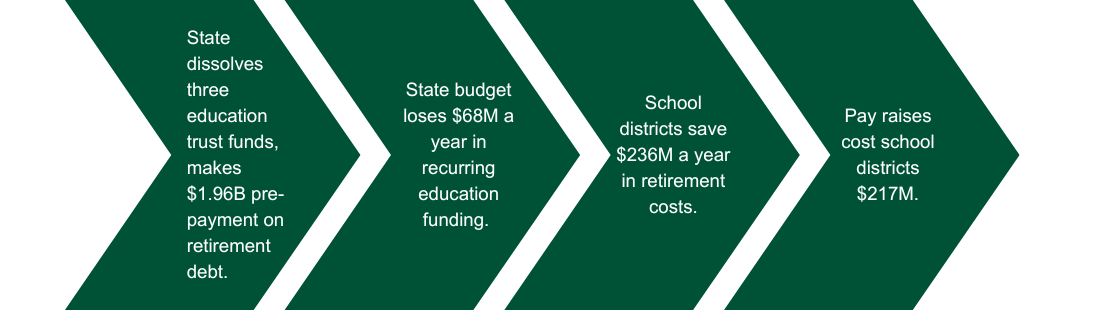
Amendment 3 aims to provide public school teachers with a permanent pay raise through an unusual financial maneuver: It would eliminate three constitutionally protected education trust funds – the Education Quality Trust Fund, the Quality Education Support Fund and the Education Excellence Fund – and use the money in those funds to make a one-time, pre-payment on debt held by the Teachers Retirement System of Louisiana (TRSL). The lump-sum payment of nearly $2 billion would reduce the amount of money local school districts have to spend each year on retirement benefits. School districts would be directed to spend the savings on a salary increase of $2,250 for teachers and $1,125 for school support staff starting with the 2026-2027 school year.
Analysis
Louisiana’s public school teachers and support workers have long been underpaid compared to their peers in other states, and have gone nearly four years without receiving a permanent pay raise from the Legislature. In lieu of permanent pay raises, the Legislature has provided annual stipends of $2,000 (for teachers) and $1,000 (for support workers) since 2023-24.
Amendment 3 was lifted from a proposed constitutional amendment that voters rejected in March 2025. The difference is that last year’s amendment was much broader in scope, as it overhauled Article VII of the state constitution, while this amendment is narrowly tailored to education funding.
If the amendment were to pass, the permanent salary increases would replace the $2,000 and $1,000 stipends teachers and support staff have received for the last three years, but which are not funded in the proposed state budget for the 2026-27 budget year. When the loss of the stipends is taken into account, the net increase in pay would be only $250 for teachers and $125 for support staff.
There are significant drawbacks to this approach. The interest earnings generated by three constitutionally-protected funds have been used to fund education programs at every level for decades. Interest earnings from the Education Excellence Fund provides funding for supplementary instruction in K-12 schools and adds seats to the state’s early childhood education program. The Education Quality Trust Fund, by way of the Louisiana Education Quality Support Fund, sends tens of millions of dollars to the state’s higher education and K-12 schools each year.
The Legislative Fiscal Office estimates that the interest and investment dollars generated by these funds in FY 2023-2024 totaled $68 million. In FY 2025-2026 recipients requested to spend over $77 million from those funds. That revenue would disappear if Amendment 3 passes.
Lawmakers passed legislation to carve out $11 million special funding to prevent the loss of seats in the state’s early childhood education program, but it remains unclear if lawmakers will find funding for the other initiatives that would lose their long-term revenue source if Amendment 3 passes.
| Recipient | Amount |
| Education Excellence Fund | $39,830,471 |
| Louisiana Quality Education Support Fund (8g) | $20,500,000 |
| Louisiana Quality Education Support Fund Board of Regents | $17,000,000 |
| TOTAL | $77,330,471 |
Emptying the funds would allow for a lump-sum payment of $1.96 billion into TRSL. The Legislative Fiscal Office estimates that such a payment would translate to $236 million in annualized savings until 2029. However, those legislative economists say the ultimate impact of the changes could not be known until the funds are liquidated and the debt payments are made.
The Legislative Fiscal Office estimates the pay raises would cost local school districts an estimated $217 million. An estimated $17 million of that would go to teachers who are not covered by TRSL. Teachers at charter schools typically do not participate in the state-run teachers retirement system and thus would not realize any savings from the early repayment of retirement debt and would require an additional appropriation to receive the same pay increase as their peers.
Lawmakers have included language in the proposal that tightly restricts how those savings are spent, ensuring that every teacher and support worker receives the mandated raise before the funds are used for any other purpose. It is unclear if any additional savings will be realized.
Amendment 3 is the Legislature’s attempt to get a free lunch – to get teachers a politically popular pay raise without using state dollars. That is a major policy change, as state lawmakers have traditionally financed teacher pay raises through the Minimum Foundation Program – the constitutionally protected funding mechanism that sends money for public school districts through a per-pupil formula.
Amendment 4
What it says
Do you support an amendment to allow a parish to reduce or exempt property tax on property held as business inventory and to provide for the classification of Public Service Property?
What it does
The amendment creates a framework and sets up incentives for local governments to permanently eliminate or reduce property taxes on business inventory. To mitigate the loss of revenue, the state would pay local taxing authorities a one-time incentive amounting to three times the amount of inventory tax collected in 2026, with a maximum of $15 million. The incentives would be paid out of the Revenue Stabilization Fund.
Parishes that choose to phase out their inventory tax over five years, instead of all at once, would have their incentive payments capped at $10 million. Even parishes with negligible inventory tax collections would be eligible for a minimum incentive payment of $1 million if they choose to eliminate the tax.
The inventory tax could only be eliminated with the unanimous consent of the parish government, the sheriff and the school board – the entities that get revenue from the tax. If passed, the amendment would forbid state lawmakers from passing legislation to eliminate the inventory tax statewide.
Analysis
Louisiana is one of 14 states that taxes business inventory as property. The Legislative Fiscal Office reports that parishes collected approximately $530 million in inventory taxes in 2023. The money from the tax supports local programs and services such as schools, parks, police and code enforcement. In a handful of parishes – particularly those with heavy industry – the inventory tax is a significant source of local tax revenue. But in most parishes, with little industrial presence, inventory tax collections are not a significant revenue source.
For more than three decades the state has provided a tax credit – essentially a rebate – for inventory taxes paid at the local level. Starting in July 2026, those credits will no longer be available for C-Corporations, but will be maintained for individuals and pass-through corporations.
Supporters of the amendment believe inventory taxes are a deterrent to business investment, and that parishes that decide to eliminate their tax could gain a competitive advantage against parishes that still charge the tax. But Louisiana already provides some of the most generous tax breaks in the country to manufacturing corporations, and it has not deterred investments in the industrial corridor along the Mississippi River.
While local governments would have the authority on the front end to eliminate the tax, the decision would be irrevocable once it’s made. Parishes could not change their mind and put the tax back on their books.
The state constitution already sharply restricts how parishes, school boards and sheriffs can raise revenue to support their communities. The Industrial Tax Exemption Program forces communities to give up property tax revenues to manufacturing corporations, the Homestead Exemption limits homestead property tax collections, and the constitution also bans real estate transfer taxes and local income taxes. These limitations are a major reason why Louisiana’s local sales taxes are the highest in the country, on average. Sales taxes are considered a regressive tax, as they hit low-income households harder than those at the top.
The inventory taxes covered by this amendment are primarily paid by large corporations and businesses. Parishes that eliminate this tax will have to either have less revenue to spend on community services – or they will have to make up for the lost revenue by raising property or sales taxes.
Municipalities – and voters – should carefully consider whether the potential economic benefit and the one-time influx of cash is worth permanently sacrificing yet another piece of their taxing authority.
Amendment 5
What it says
Do you support an amendment to change the mandatory retirement age for judges from seventy to seventy-five, provided that a judge may continue to serve to complete a term of office? (Amends Article V, Section 23(B))
What it does
The current constitution says state judges cannot be elected after turning 70. Judges who hit that age during their term in office can continue serving out their term. The amendment raises the mandatory retirement age to 75. Judges who turn 75 during their term could complete their term but could not run again.
Analysis
Judges are the only elected officials in Louisiana who face a mandatory retirement age, which has been in place since the current constitution was adopted in 1974. The Public Affairs Research Council of Louisiana reports that Louisiana is among 31 states that have a mandatory retirement age for judges, and that 18 states set the retirement age at 70. The remaining 13 states require judges to retire at anywhere from 72 to 90 years of age, with seven of them setting the age at 75.
Judges are the only elected positions in Louisiana that come with a mandatory retirement age. This amendment would give judges more time in office. Constitutional restrictions aside, voters are always free to pass their own judgment on whether a judge is too old to be effective.