

Why the budget?
The state budget is far more than a ledger of revenues and expenditures; it is a profound moral document that clearly reflects Louisiana’s priorities and values. Every line item, from funding for public schools to allocations for road repairs and healthcare services, represents a collective decision about who and what we value as a state. These choices, debated in the Capitol, have a direct and tangible impact on the lives of every Louisianan, shaping the quality of our communities, the strength of our economy, and the opportunities available to our children. In this way, the budget serves as the state’s most concrete statement of its vision for the future, revealing whether we are investing in shared prosperity or accepting a status quo of inequality and unmet potential.
The state budget is the primary tool through which our communities pool their resources to make a transformative impact. It is the means by which we ensure children have access to a quality education, families can rely on safe drinking water and well-maintained highways, and our neighbors can receive medical care in times of need. These investments in shared infrastructure and public goods are the foundation of economic mobility and community well-being. When we strategically and equitably allocate our collective resources, we build a stronger, more resilient Louisiana where everyone has the chance to thrive.
This Budget Primer by Invest in Louisiana is designed to present information on understanding how Louisiana uses the appropriations process to fund state services and underscore the critical connection between fiscal policy and everyday life. By understanding how the budget is crafted and where the money goes, Louisianans can more effectively advocate for investments that reflect our common values and address our most pressing challenges. An informed public is essential to ensuring that our state budget truly works for all people, building a Louisiana that is prosperous, just, and full of opportunity for generations to come.
Where does the money come from?

Source: Louisiana Division of Administration
The money lawmakers appropriate each year comes from a variety of sources. These means of finance can be divided into five major categories.
- Federal Funds (44.3% | $23.7 billion) Revenue received from the federal government through a variety of programs. Some federal funds are earmarked for specific non-recurring expenses, like coastal restoration projects; others support ongoing programs, like Medicaid. The state is often required to put up “matching dollars” to draw down these federal funds.
- State General Fund (22.8% | $12.2 billion) The primary destination of tax dollars collected by the state of Louisiana. It includes all state revenues that are not statutorily or constitutionally dedicated as well as a portion of state budget surpluses after constitutionally mandated deposits to the Budget Stabilization Fund and the paying down of retirement debt.
- Statutory Dedications (17.3% | $9.2 billion) Tax revenues dedicated by law or the constitution to specific purposes, such as gas taxes that are dedicated to the Transportation Trust Fund.
- Fees and Self-Generated Revenue (44.6% | $17.9 billion) Fees and self-generated revenues are monies that state agencies generate on their own to offset the cost of services, like college tuition, hunting license fees, admission to state parks.
- Interagency Transfers (4.6% | $2.5 billion) Funds that flow from one part of the state government to another.
Federal Funds
The largest share of the funds the state appropriates in a given fiscal year comes from the federal government. This money supports health care, food assistance, education, and disaster recovery programs. Federal funding for the state’s Medicaid program flows through the Louisiana Department of Health, where it helps finance health coverage for people with low incomes, the elderly and people with disabilities. LDH also utilizes federal funds to administer the Supplemental Nutrition Assistance Program (SNAP) food assistance program, which helps qualifying families put food on the table.
These and other programs provide an important safety net for hundreds of thousands of struggling Louisianans. Nearly half of the Department of Education’s $8.2 billion budget comes from the federal government. The state is often required to put up “matching” dollars to draw down federal funds.

The exact percentage of the budget comprised of federal funds fluctuates year to year, but a Pew analysis of all 50 states’ revenue sources for the 2022-23 fiscal year found that Louisiana ranked first with more than half of state’s appropriations coming from federal dollars.

State general fund
The two largest sources of state tax revenue, by far, are sales and individual income taxes. Sales taxes are projected to bring in more than $5.7 billion in FY2025-26, with the vast majority coming from the 5% general sales tax charged on most purchases. Personal income tax comes in a distant second at $3.7 billion.
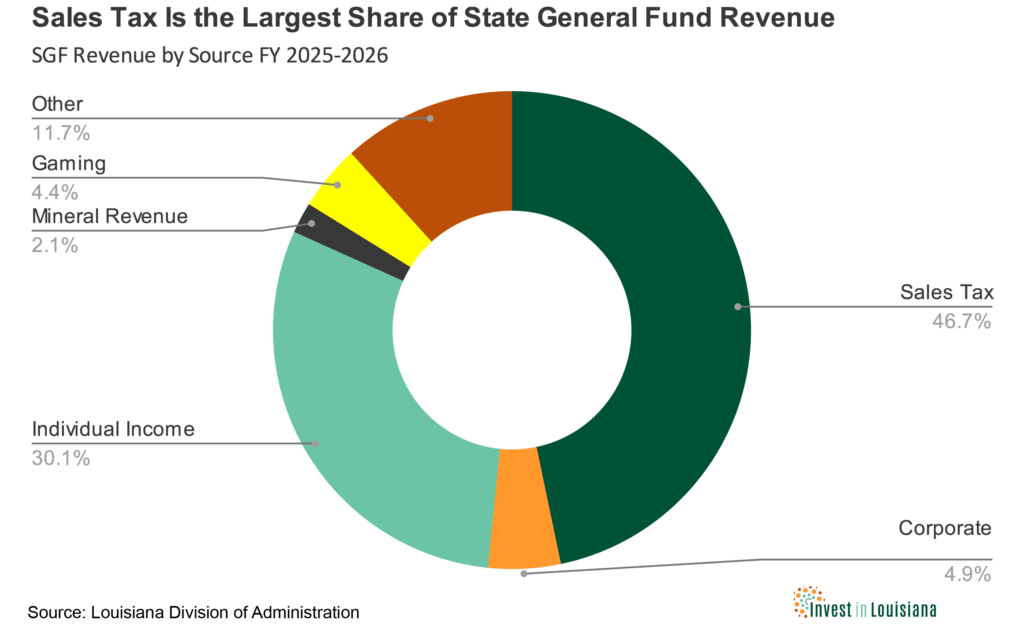
The share of state revenue coming from sales taxes is expected to rise after recent changes to Louisiana’s tax code abandoned the state’s graduated personal income tax brackets for an increased standard deduction and a flat 3% personal income tax. Lawmakers offset the lost revenue by increasing the state’s general sales tax to 5%.
To mitigate wide fluctuations, the state limits the amount of corporate tax collections that flow to the state general fund each year to $600 million. The excess is routed to the Revenue Stabilization Fund. Due to the recent elimination of the state’s corporate franchise tax, and deep reductions in corporate income tax rates, it remains to be seen whether annual revenues will reach that $600 million threshold.
The state government also collects significant revenue from the gaming industry (casinos, racetrack slots and video poker), insurance premium taxes, and smaller sums from oil and gas extraction (royalties and severance taxes) and excise taxes on things like tobacco and alcohol.
As a general rule, state revenues improve when the economy is growing and typically decline during recessions. Louisiana has a “rainy-day fund” (the Budget Stabilization Fund) that can be tapped to prevent drastic cuts to services that citizens depend on.
Discretionary vs. Non-Discretionary Dollars
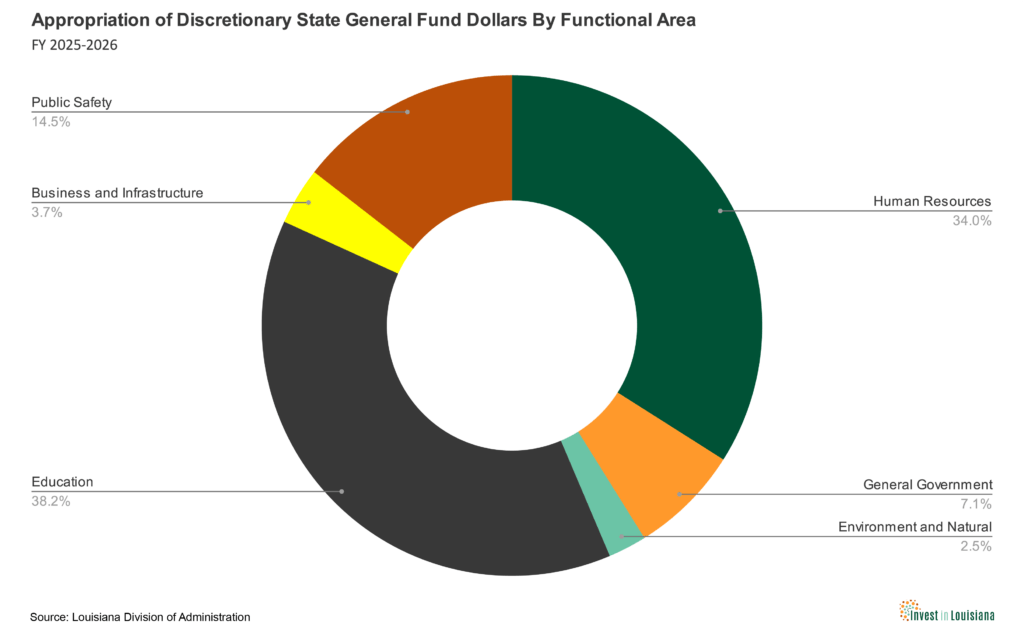
Most of the taxes Louisiana collects go to the State General Fund. More than two-thirds (71%) of the general fund is considered “non-discretionary,” meaning those funds are legally obligated and not available for the Legislature to use as it wants. This makes the discretionary portion of the general fund one of the few parts of the budget the Legislators may cut when revenues are down, putting core programs at risk.
Non-discretionary spending includes spending required by court order, state law or the state constitution. For example, most state spending on public K-12 schools is non-discretionary. State school funding is distributed through the Minimum Foundation Program (MFP) formula, which is developed each year by the Board of Elementary and Secondary Education, and subject to an up-or-down vote by the Legislature.
After you strip away federal dollars, self-generated money, and non-discretionary general fund dollars, there are fewer than $3.5 billion in a $53 billion state budget that legislators fully control. The vast majority of this money is currently funding higher education, healthcare and human services such as child welfare programs.

Important Terms
Appropriation Authority the legislature gives an entity to expend funds up to an authorized amount. Good for one fiscal year.
Budget Request A proposed operating budget for the next fiscal year. Created each year by each budget unit and submitted to the division of administration by November 1st. See R.S. 39:32 for more detail.
Deficit When expenditures exceed revenues at the end of a fiscal year. Existence is determined in mid-August, once all prior year budget items are closed out. This term is specific to prior fiscal years; it is not used in relation to the current fiscal year.
Excess Revenues recognized in the current fiscal year in excess of prior projections. Officially occurs when the Revenue Estimating Conference adopts a revenue forecast that shows an increase in current fiscal year collections. Unlike a surplus, appropriation of excess revenues is not limited to specific expenditures.
Shortfall Occurs when the Revenue Estimating Conference lowers the revenue forecast for the current fiscal year. Since the appropriations bills for the current year were funded and passed based on earlier (and higher) forecast figures, the new forecast will be lower than the amount of appropriated funds.
Discretionary Expenses Expenditures for which there is no existing legal requirement binding the state to pay.
Non-discretionary Expenses Expenditures whose payment is mandated by the constitution, court order, or contract (debt service). Unavoidable expenses.
Non-recurring revenue A short-term source of funds. Cannot be spent on recurring expenditures (such as payroll, utilities, etc.). For revenue to be reclassified from non-recurring to recurring, it must be collected for at least 3 consecutive years. Non-recurring revenue can only be spent on certain constitutionally defined items. A budget surplus is a common example of non-recurring revenue.
Means of Finance (MOF) The various sources of funds used to pay budgeted expenses.
Executive Budget The budget proposed by the governor to fund operations for the next fiscal year. Proposed expenditures cannot exceed the official forecast of the REC.
(source: Common Budget Terms, House Fiscal Division, 2024 https://house.louisiana.gov/housefiscal/DOCS_OPERBDGT/Common-Budget-Terms.pdf)