
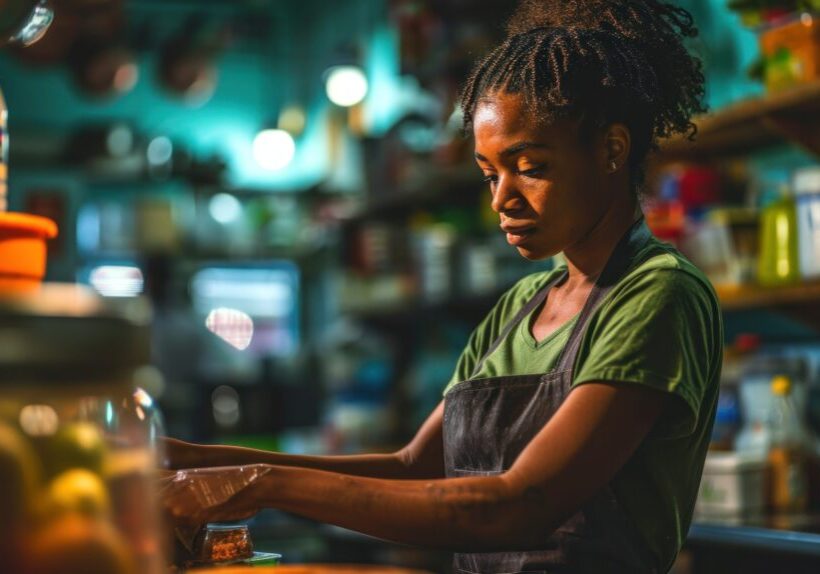
The roots of today’s affordability crisis lie in the poverty-level wages paid to far too many of the workers who keep our economy running. These workers need a higher minimum wage to make ends meet for themselves and their families.
House Bill 353 by Rep. Tammy Phelps would establish a minimum wage of $12 an hour in 2027 and $15 an hour by 2029. After 2029, the minimum wage would be indexed to inflation, meaning it would continue to rise alongside the cost of living.
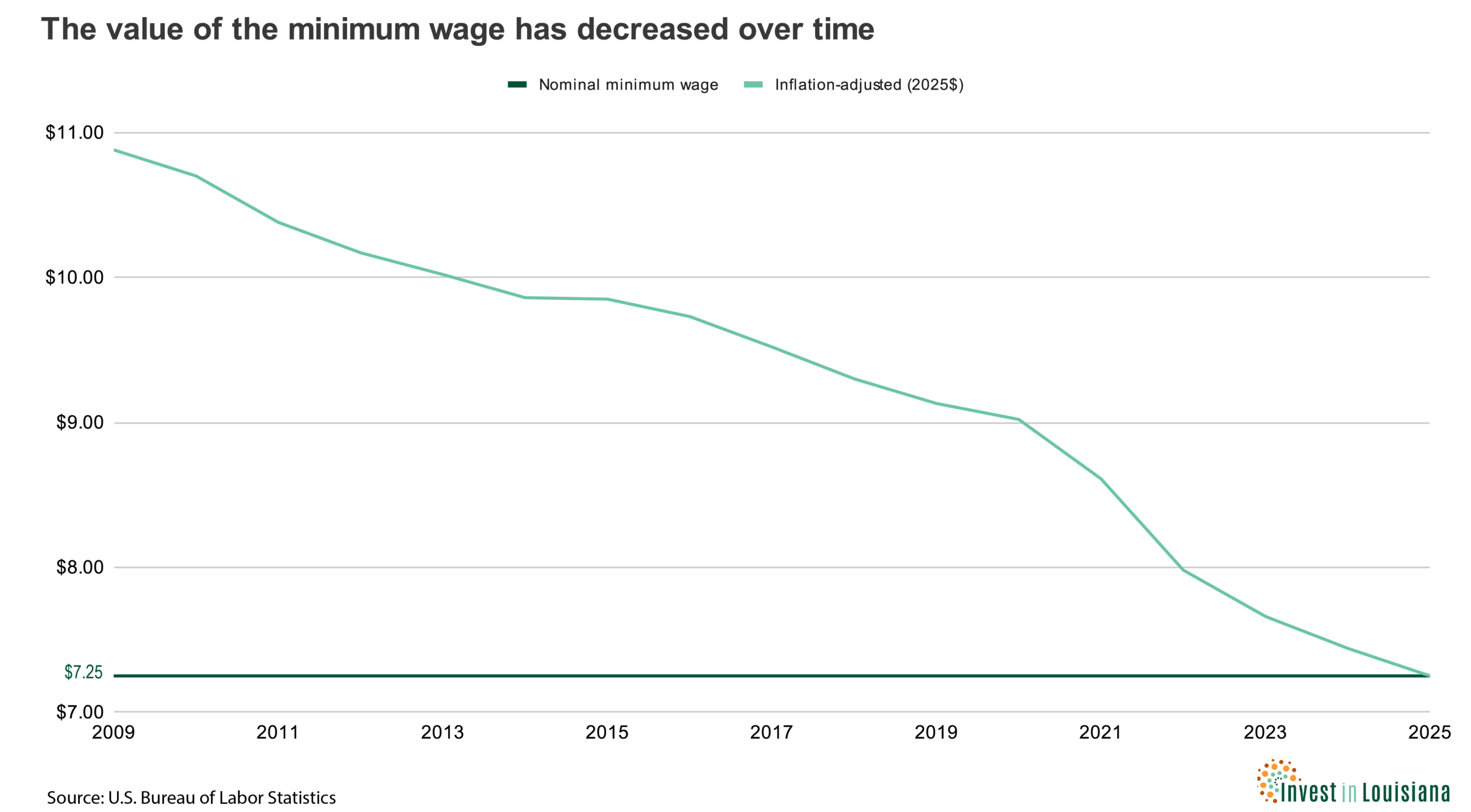
Louisiana is one of only five states–all in the South–without a state minimum wage. That leaves many workers earning at or near the federal minimum of just $7.25 an hour–an amount that has not increased since 2009. Such wages do not cover the cost of living in any parish in the state. Today, minimum-wage workers in our state working full-time will still be below the poverty line.
The current minimum wage has lost more than 30% of its purchasing power since 2009. This stagnation makes it difficult for Louisianans to survive and provide for their families even when working.
According to the 2025 ALICE (Asset Limited, Income Constrained, Employed) report from the Louisiana Association of United Ways, half of Louisiana households cannot afford basic expenses or save for emergencies–the highest rate in the nation. This economic insecurity forces many Louisianans to make impossible choices, like deciding whether to pay for utilities or a car repair, or whether to buy food for their kids or fill a prescription for aging parents.
Who benefits from raising the wage?
Workers living in poverty or near poverty, tipped workers, and workers without a high school degree would benefit the most from a higher minimum wage. Additionally, retail workers, single parents, and Black workers in Louisiana would also see disproportionate gains. An analysis by the Economic Policy Institute found that more than 1 in 5 Louisiana workers (21.2%) would get a raise by 2029- either directly or indirectly – if HB353 becomes law. That’s 385,900 Louisianans–more than the entire population of the city of New Orleans.

More than two-thirds of Louisiana workers (69.9%) living in poverty would bring home more money under HB353, benefiting the most of any subgroup from the wage increase. Workers in the restaurant (55.6%), hospitality (44.6%), retail (40%), and arts and entertainment industries (36.8%) would see the greatest gains from a wage increase, with over half of all tipped workers (50.7%) across the state seeing increased wages.

Who supports raising the minimum wage?
Raising the wage is popular across Louisiana, and several of our Southern peers with vibrant, growing economies have already raised their minimum wage. A 2019 statewide survey by LSU’s Manship School of Mass Communications found that 81% of Louisianans supported raising the minimum wage.
Arkansas, Florida, and Missouri have all passed minimum wage increases–and Oklahoma has the chance to pass a wage increase this year. Nationally, 19 states increased their minimum wages at the beginning of 2026, with over 8.3 million workers benefiting from these increases. As of 2026, there are more workers in states with a minimum wage of at least $15 an hour than in states using the federal minimum wage. There is no economic justification for why workers in Louisiana cannot also be paid higher wages.
Higher minimum wages strengthen consumer spending and boost economic activity. When workers have more money, they spend it in their local communities – creating a virtuous cycle that helps us all. For example, a national $17 minimum wage by 2028 would generate $86 billion in higher wages for workers and would also benefit communities across the country.
A hard day’s work in Louisiana should pay at least as much as it does in Florida or Missouri. Our workers deserve at least that much for themselves, their families, and their futures. House Bill 353 honors and rewards hard work and provides all Louisianans with a path to prosperity.