

The state budget is the best available tool to ensure every Louisiana family has enough food to eat, access to good schools and high quality health care, and that a safety net exists for those who fall on hard times.
In late January, Gov. Jeff Landry made a $47 billion budget request to the Legislature for the 2026-27 fiscal year. Described as a “standstill” budget, it would keep most state programs financed at current-year levels. It’s the third straight year of standstill budgets, and it comes at a time when families are experiencing ever-higher costs for basic necessities.
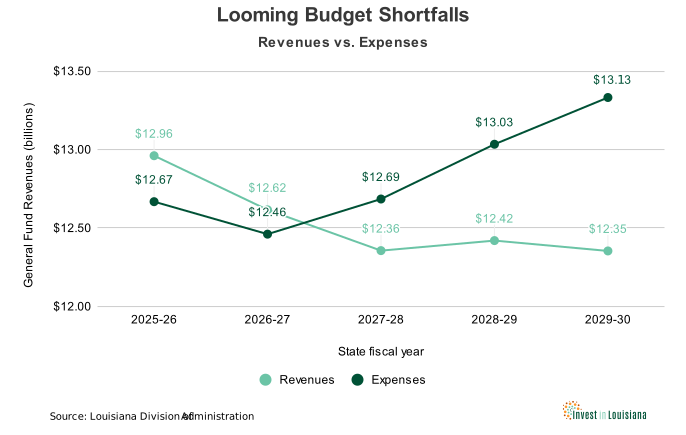
It also comes during a precarious time for the state’s finances. State economists are projecting a significant budget shortfall next year and even larger gaps in future years. That’s because Louisiana is balancing its budget with temporary tax revenues, and faces much higher costs in the coming years for federal food assistance and Medicaid thanks to actions taken by Congress and President Trump.
Unless legislators take steps to raise more revenue, these budget gaps will soon threaten the state’s ability to educate children, train workers and ensure access to health care and social services that are critical to a strong economy.
Despite these constraints, the governor proposes to spend $44 million more next year on Education Savings Accounts – a program that steers public dollars to private schools, which don’t operate with the same performance measures and transparency as public schools.
The administration also proposes more money for prisons, nursing homes and scholarships for vocational and technical training. Louisiana is also taking on $42 million in new costs for administering the Supplemental Nutrition Assistance Program (SNAP) because of a new federal law that pushes some of the costs of public benefit programs from the federal government to states.
There is $75 million set aside for a new corporate subsidy program where the state would cover up to 22% of the salaries for certain new jobs.
Taking on these new expenses means other priorities, particularly education, get shortchanged.
Left out of the budget plan is a pay raise for public school teachers and support workers, who last received a permanent pay raise from the Legislature in 2022. While Louisiana’s educators are doing heroic work – math and reading scores have leapfrogged other, wealthier states – they are paid nearly $6,000 less per year than their Southern counterparts.
State support for higher education is being cut by 3%, and funding for early childhood education is frozen at current levels, leaving out thousands of families who need quality, affordable child care so they can go to work.
In lieu of a permanent teacher pay raise, the Legislature last year authorized a $2,000 stipend for teachers ($1,000 for support workers) that educators receive on top of their normal salaries. That stipend is not renewed in the proposed budget, meaning teachers could see a cut in their overall pay next year.
Instead of a pay raise, legislators have proposed a constitutional amendment that goes before voters on the May 16 ballot. The amendment would do away with three constitutionally protected state funds that support various education programs. The money in the funds would be used to pay down debt in the Teachers Retirement System, and local school districts would be required to use the savings to provide teachers with a $2,250 per year raise, with support workers getting half that amount.
It’s a risky move, as voters by a 2-to-1 margin rejected a nearly identical plan last year, although it was wrapped up in a much larger and more complicated constitutional amendment that made other changes to state tax policies. If legislators reject the amendment again, the Legislature would need to come up with $200 million in the budget just to keep teacher pay at current-year levels.
So what can the Legislature do?
First, legislators can avoid making the problem worse by doubling down on more tax cuts. Gov. Jeff Landry has said he might call a special session to make deeper cuts to the state’s personal income tax, which was already cut in 2024 as part of a far-reaching tax plan that shifted more of Louisiana’s tax burden from wealthy people and profitable corporations to middle- and low-income households.
Additional tax cuts would only create bigger budget shortfalls, and force cuts to education, health care and other programs that families rely on.
Next, policymakers should shift money around in the budget to ensure that teachers and families with young children are prioritized. The new spending being proposed for prisons and an unproven private school voucher program would be better used making sure classrooms can recruit and retain highly qualified teachers, and that families on waiting lists can access affordable child care.
Looking ahead, policymakers should stop the current race to the bottom on tax policy, and instead restore some fairness to a system where people with the lowest incomes pay state and local taxes at nearly twice the rate of those at the very top. Louisiana’s tax structure is among the most regressive in the country, yet new research from the State Revenue Alliance found that states with more progressive tax systems rank higher on a range of economic and quality-of-life measures.