
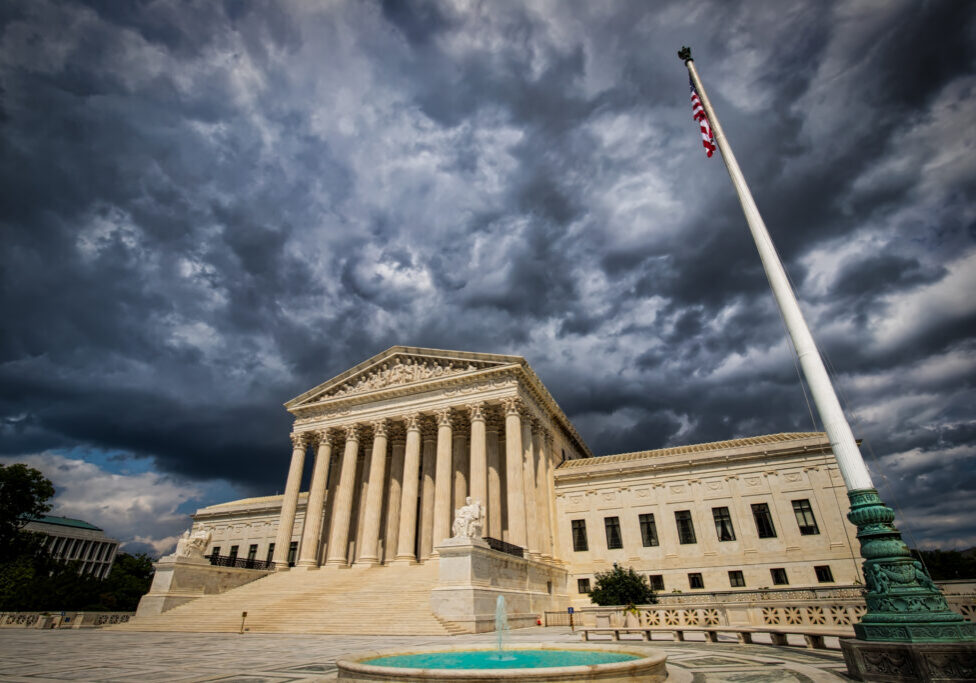
A conservative majority on the U.S. Supreme Court struck down a key pillar of the Voting Rights Act on Wednesday, ruling that Louisiana’s Sixth Congressional District constitutes an “unconstitutional racial gerrymander.” The ruling set off a political scramble, with Gov. Jeff Landry telling allies that he plans to suspend the May 16 primary elections so the state Legislature can pass a new congressional map. The Washington Post’s Dan Merica and Patrick Marley:
It’s unclear whether the governor’s suspension would apply only to primaries for the six House seats, or include other elections, including the heated Senate primary that pits incumbent Sen. Bill Cassidy (R) against Rep. Julia Letlow (R). Louisiana has six House seats, two of which are held by Democrats. … If Landry suspends the House primaries but not other contests, primary voters would have to go to the polls twice, just weeks or months apart from each other.
Adam Ganucheau of Verite News explains how the consequences of the Callais ruling will ripple beyond the halls of Congress:
Louisiana’s legislative districts, its judicial elections, its school boards and parish councils, could be redrawn under the shadow of a federal law that no longer means what it once did. The trickle-down effects of this ruling will have a lasting impact for years to come, shaping not just who sits in Congress, but who sits on the bench, who runs local schools, and whose neighborhoods get needed resources.
The ruling was quickly condemned by groups that have fought for voting rights. The Power Coalition for Equity and Justice called it “a sobering moment for our state and our democracy.”
Today’s decision is incredibly disappointing. But the reality on the ground remains the same. Louisiana’s congressional districts must reflect the people who live here. For too long, Black voters in Louisiana and across the country have faced barriers to full and fair representation.
The Urban League of Louisiana called it a “devastating blow to the core promise of American democracy.”
This decision is not about neutrality. It is about power. It is about who gets to shape the political landscape, whose voices are amplified, and whose votes are diluted. By imposing new, nearly insurmountable barriers to proving violations of the Voting Rights Act, the Court has effectively told states that they may systematically weaken Black voting strength—so long as they avoid leaving behind explicit evidence of intent.
Amendment targets inventory tax
Amendment 4 on the May 16 statewide ballot would create a framework for local governments to permanently eliminate or reduce property taxes on business inventory. The Times-Picayune | Baton Rouge Advocate’s Meghan Friedmann explains how the state would incentivize local governments to nix the tax:
To help make up for lost revenue, the state would give parishes that lower or eliminate the tax one-time payments of between $500,000 and $15 million, depending on how much inventory tax they collect. The parish sheriff, school board and parish governing authority, such as the parish council or police jury, would need to agree to get rid of the tax, according to Steven Procopio, president of the Public Affairs Research Council of Louisiana, a nonpartisan good government group.
The one-time payment would not replace the recurring revenue stream the inventory tax provides:
Jan Moller, executive director of Invest in Louisiana, a Baton Rouge-based progressive think tank, raised concerns that a parish’s decision to get rid of the inventory tax would be “irrevocable” – and that doing so could shift the tax burden from corporations to needy Louisianans. “You are giving up a permanent ongoing revenue source in exchange for a one-time payment,” he said. “You either have to make cuts to your budget or you have to replace that revenue with some other revenue.”
Tracking the loss of food assistance
Participation in the Supplemental Nutrition Assistance Program declined by more than 3 million people in the first six months after the harmful federal megabill was signed last July. That’s according to new analysis from the Center on Budget and Policy Priorities:
SNAP participation has fallen in every state and in some, the drop is particularly alarming. More recent data from state agencies show that the number of Arizonans who participated in SNAP in March 2026 is less than half the number that participated last July. SNAP participation has dropped by more than 10 percent since July 2025 in Connecticut, Florida, Illinois, Kansas, Louisiana, Massachusetts, South Carolina, Tennessee, Texas, Utah, and Virginia according to state agencies’ data, and by more than 10 percent in Nevada and Oklahoma according to USDA data.
The decline in SNAP participation is not due to increased economic well-being or decreased need:
Labor force data show that the unemployment rate was flat between July 2025 and March 2026, the most recent data available. A more likely explanation for why people are losing access to food assistance is that states are now facing new challenges as they respond to the cuts in H.R. 1 — the largest in the program’s history. The deep cuts to federal funding for SNAP are shifting significant new costs to states.
The federal law cuts SNAP by $187 billion over the next decade and imposes new, strict work reporting requirements and eligibility checks.
Tax the oil companies to restore the coast
A recent U.S. Supreme Court ruling that wipes out a $745 million judgment against the Chevron oil company is bad news for Louisiana’s ongoing efforts to restore its coastline. The unanimous ruling strikes a major blow against ongoing efforts to force oil companies to pay for the environmental damage they’ve caused. To make up for the revenue loss, conservative columnist Quin Hillyer suggests reviving an old idea: Taxing the fossil fuel industry through a Coastal Wetlands Environmental Levy (CWEL):
Rather than trying to force oil companies to pay for long ago activity that quite arguably was legal at the time, let’s just put a low, predictable fee on their activity — per unit volume of oil or gas transported through pipelines — going forward. End the legal bills, end the all-or-nothing risk for both sides: Just provide transparent, consistent, affordable levies. It would be a win-win for everybody, especially for coastal communities that need projects sooner rather than later, and with expectations rooted in actual legislation rather than in pie-in-the-sky promises from trial lawyers.
Number of the Day
92.6% – Share of Louisiana kindergarteners who were vaccinated for measles in the 2024-25 school year. A 95% vaccination rate is necessary to prevent outbreaks, according to the Centers for Disease Control and Prevention. Louisiana recently confirmed its first measles case for 2026. (Source: Centers for Disease and Control via Governing)